Ruby Wireless Vibration Sensor

Parameters Performance
Axis 3-axis, X, Y, Z
Full acceleration range ±25 g, ±50 g, ±100g depending on models selected.
Sensor usable bandwidth 0.5 Hz to 6.5 kHz for Z axis
0.5 Hz to 4 kHz for X and Y axis
Tolerance of Frequency Response for Z axis 0.5 Hz to 6,500 Hz: +/- 1.0 dB
Tolerance of Frequency Response for X or Y axis 0.5 Hz to 4,000 Hz: +/- 1.0 dB
Typical Noise Density (100 Hz, 1 kHz) RMS < 60 μg /√Hz
Amplitude Accuracy 2%
Internal A/D resolution 24 bits
Non-volatile memory 256 MB (store the measurement data)
Signal Processing capability Raw time waveforms, Digital filters, data window, FFT spectrum, averaging, simple order extraction, demodulation spectrum that required by the VDS software
Data sampling rate 16 kHz, 8 kHz, 4 kHz, 2 kHz, 1 kHz, 500 Hz, 250 Hz, 125 Hz
Data recording Total usable recording size: 62 million points.
Longest recording duration is roughly 3,900 seconds for single axis, at 16 kHz sampling frequency, or 1,300 seconds for 3-axis
Number of FFT lines per block 112, 225, 450, 900, 1800
FFT block size 256, 512, 1024, 2048, 4096
Measurement modes Scheduled data save, on-demand data save, continuous recording
Data transfer
  • Receive and send the measurement configuration such as frequency range or spectrum lines.
  • Acquire and send the measurement data in a predetermined period (minutes, hours, days)
  • Acquire and send the measurement data based on host commands transmitted by the wireless network
Communications
Supported Communication Protocols ISA100.11a, BLE 5.0, USB
Encryption in Wireless communications Encrypted using AES-128 (ISA 100.11a and BLE 5.0)
Encryption Compliance FIPS 140-2 compliant encryption for ISA an BLE modes
Default Communications Protocol ISA100.11a, periodic low power data transfers using ISA100.11a mesh network
ISA100.11a frequency bands 2.4 GHz ISM Band
ISA 100.11a Max Data Rate 250 kbps
Typical ISA Wireless Range 100 meters sensors to ISA-100 gateways; 80 meters sensor to sensor, line of sight (Actual range depends on obstacles present, gateway antenna type, etc.)
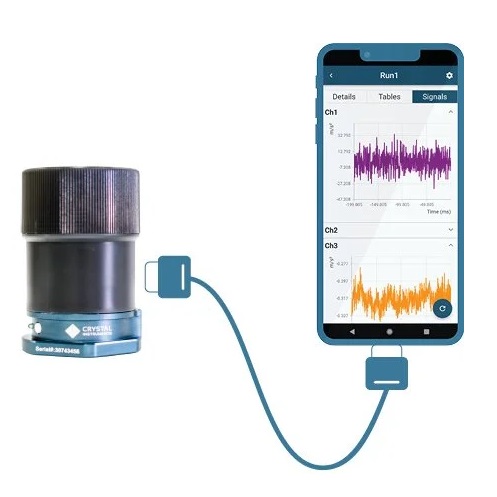
USB Interface USB-OTG, used to set up the sensor, calibration and download the data to a local PC. Can be used as a simple vibration data collector
Bluetooth BLE 5.0
Bluetooth Wireless Range Typically between 10 to 100 meters indoor
Battery and Electrical
Battery type Replaceable D size 3.6V
Typical battery life for periodic data collection 36 months1
Battery life for continuous data collection 170 hours
Electrical isolation > 108 Ohm
Physical
Weight 365 grams (including battery)
Dimensions 63 mm (bottom, hexagon shape) x 94.2 mm (height)
Push buttons Switch modes from ISA100, Bluetooth, USB
LED indicator 0.5s Blink: ISA100
1s Blink: Bluetooth
Solid Green: USB
Mounting 5/16” -24 UNF-2B female
Environmental
Protection Grade IP 67 (Protected from dust, immersible up to 1 m water)
1 Based on two (2) measurements per week
Category:

Machine Condition Monitoring

The Ruby wireless vibration sensor is a battery powered, high-precision, low-noise ultra-compact device that measures vibration signals in acceleration quantity on mechanical structures.

Internally, it consists of a 3-axis sensor component, an ARM processor, 24-bit ADC (Analog to Digital Converter), flash memory storage and a battery.

Its interface features an RF transceiver that supports the ISA-100 wireless protocol, Bluetooth connectivity, and a USB.

Minimize EMI

Some applications restrict the total EMI (electromagnetic interference) generated by sensors and their network. Sensors can be awakened in batches to minimize their EMI impact and placed into transmission mode at different time slots.

Industrial Wireless Networking

ISA-100.11a is an industrial wireless networking standard designed to support reliable and secure communication in industrial automation and control systems. It is particularly popular for wireless sensor networks, offering a self-organizing, multi-hop mesh architecture that enhances reliability, scalability, and real-time data transfer.

Remote Data Recording & Signal Processing

An onboard processor can realize the digital filtering, triggering, data window, FFT, auto-power spectrum and averaging operation. Demodulation spectral analysis is also available. Users can save calculated spectra along with recorded time waveforms into flash memory. These data recording and signal processing tasks can be scheduled through RCM, a PC-based Remote Condition Monitoring software.

Sampling Rates & Data Points

The highest sampling rate of ADC can go up to 16 kHz, which results in an excellent spectrum up to 6.5 kHz. The maximum data points that can be recorded are 62 million. The largest FFT size is 4096, which is sufficient for most of the machine vibration purposes.

Industry Leading High-Fidelity Device

Ruby is included amongst measurement devices with the highest fidelity offered in this industry. The noise floor of the sensor acceleration measurement is less than 100 μg /√Hz. The Z-axis vibration measurement can go up to 6.5 kHz while the X/Y horizontal axis can go approximately 4 kHz. The tolerance of measurement is typically less than +/- 1.0 dB.
Reviews

There are no reviews yet.

Be the first to review “Ruby Wireless Vibration Sensor”

Your email address will not be published. Required fields are marked *

Scroll to Top